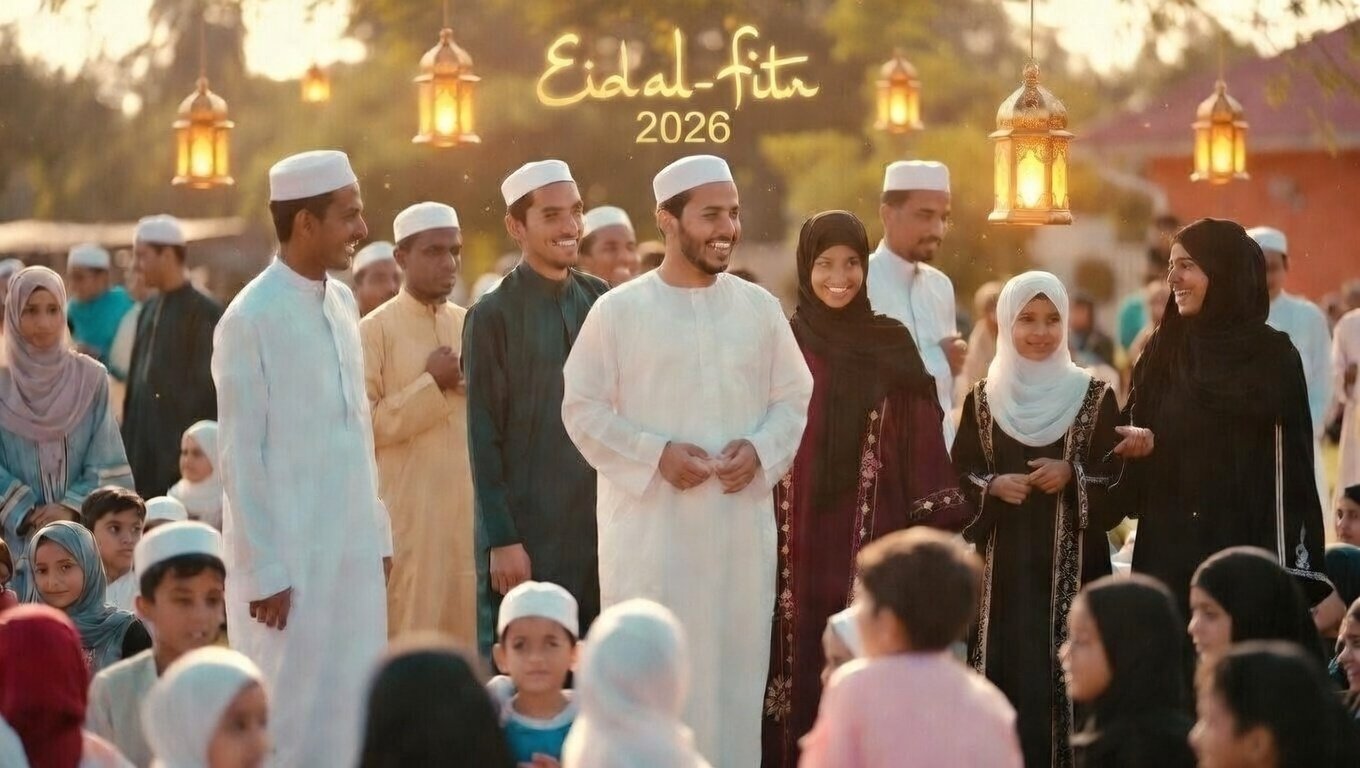
Eid al-Fitr 2026 in the UK
Your complete guide — confirmed date, Eid prayer times, Zakat al-Fitr, city celebrations and practical tips for British Muslims across England, Scotland and Wales.
Eid al-Fitr 2026 is almost here. After 29 or 30 days of fasting, early mornings, long tarawih nights and deep reflection, British Muslims are preparing for one of the most beloved days of the Islamic year.
This guide is written specifically for Muslims living in the UK — covering the confirmed expected date, Eid prayer timings, Zakat al-Fitr, city-by-city celebrations, food and practical advice to make your Eid smooth, meaningful and joyful. Whether you are a seasoned observer or attending your first Eid prayer, everything you need is here.
📅When Is Eid al-Fitr 2026 in the UK?
Eid al-Fitr 2026 is expected on Friday 20 March 2026, subject to official moon sighting confirmation. Celebrations begin from the evening of Thursday 19 March 2026 after Maghrib prayer, when the crescent moon of Shawwal is expected to appear over the UK horizon.
| Event | Date |
|---|---|
| Last day of Ramadan fasting | Thursday 19 March 2026 |
| Moon sighting watch (Shawwal crescent) | Evening of Thursday 19 March |
| Eid al-Fitr — expected date | Friday 20 March 2026 |
| Eid prayers begin across the UK | Approx. 7:00am – 9:30am on 20 March |
| Alternative (if moon not sighted on 19th) | Saturday 21 March 2026 |
Why can the date shift? Eid is determined by the physical sighting of the crescent moon — not a fixed printed calendar. The New Crescent Society carries out official moon sightings across the UK, and most British mosques follow local or verified international announcements. If the moon is not visible on the 29th night of Ramadan, fasting continues one more day and Eid moves to Saturday 21 March.
🌙What Is Eid al-Fitr? The Meaning Behind the Day
Eid al-Fitr translates from Arabic as "Festival of Breaking the Fast." It falls on the first day of Shawwal — the tenth month of the Islamic Hijri calendar — and marks the joyful conclusion of Ramadan, the month of fasting, prayer and spiritual renewal.
The Prophet Muhammad (peace be upon him) established Eid al-Fitr in the second year after the Hijrah, around 624 CE, following the first Ramadan observed by the Muslim community in Madinah. From those origins over 1,400 years ago, it has grown into one of the two great celebrations of Islam — observed today by over 1.8 billion Muslims across every continent.
At its heart, Eid al-Fitr is built on three inseparable values:
- Gratitude (Shukr) — thanking Allah for granting the ability to complete the fast and for the countless blessings of the month.
- Charity (Zakat al-Fitr) — a compulsory giving that ensures every Muslim, regardless of wealth, can celebrate Eid with dignity and joy.
- Community (Ummah) — coming together in congregational prayer, in family homes and in public spaces, renewing bonds of love and kinship.
One important point many overlook: fasting on the day of Eid al-Fitr is forbidden in Islam. The day is reserved entirely for celebration, gratitude, rest and togetherness — the rightful reward of a month of discipline.
For British Muslims, Eid al-Fitr also carries a deeper cultural resonance. The UK's 4 million Muslims bring heritage from South Asia, the Middle East, East and West Africa, the Balkans, Southeast Asia and beyond. Eid in Britain is, in that sense, a uniquely multicultural celebration — one that reflects both a shared Islamic faith and an extraordinary tapestry of cultures.
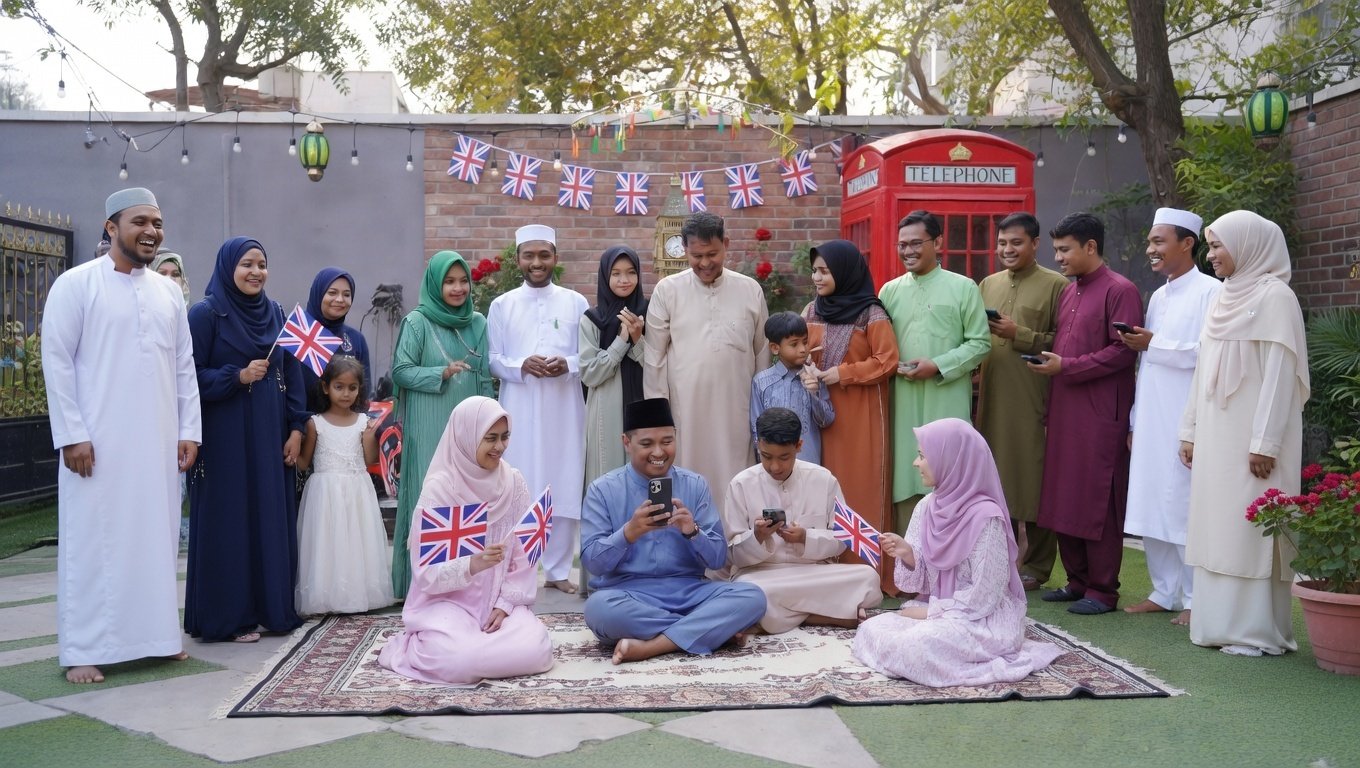
🕌Eid Morning in the UK: What Actually Happens
Eid morning across the UK has its own distinct, beloved rhythm — a blend of sunnah traditions, family rituals and the particular flavour of British Muslim life. Here is what a typical Eid al-Fitr morning looks like for millions of people across England, Scotland and Wales.
Before the Eid Prayer
- Wake up early and perform ghusl — a full ritual wash, one of the recommended sunnah acts of the day.
- Apply attar (natural perfume) and dress in new or best clothes. For children, wearing a brand-new outfit is one of the most excited-about parts of Eid.
- Eat something sweet before leaving for prayer — traditionally an odd number of dates. Fasting on Eid day is forbidden, so eating first is both sunnah and obligatory in spirit.
- Recite the Takbir aloud on the way to the mosque: Allahu Akbar, Allahu Akbar, La ilaha illa Allah, Allahu Akbar, Allahu Akbar, Wa Lillahil hamd.
- Exchange Eid Mubarak greetings with neighbours, friends and strangers on the way — the warmth of these brief exchanges is something every British Muslim knows well.
The Eid Prayer (Salat al-Eid)
The congregational Eid prayer is the centrepiece and spiritual highlight of the morning. It consists of two rak'ahs with additional takbirat at the start of each rak'ah, followed by a khutbah (sermon). It is a sunnah to take a different route home from the one taken to the mosque — a small but meaningful act.
Across the UK, Eid prayers take place between roughly 7:00am and 9:30am. Many mosques run two or three consecutive congregation times to accommodate the exceptionally high turnout. Large outdoor Eid prayers — held in parks and open spaces when the weather allows — are a cherished British Muslim tradition, with thousands gathering on open ground in scenes of quiet, powerful unity.
Popular venues for Eid prayers across the UK include Regent's Park Mosque in London, Birmingham Central Mosque, Manchester Central Mosque, Edinburgh Central Mosque and Cardiff's Al-Manar Centre — as well as hundreds of local mosques, community halls and school sports halls turned into temporary prayer spaces.
After the Prayer
Once prayers are done, British Muslim families typically head to the home of the eldest family member — parents, grandparents or in-laws — for the main Eid gathering. Children receive Eidi (gifts or money from elders), food is laid out in abundance, and the day stretches comfortably into evening with visits, phone calls and WhatsApp voice notes exchanged across the world.
🤲Zakat al-Fitr 2026: What You Need to Pay and When
Zakat al-Fitr — also known as Fitrana or Sadaqat al-Fitr — is a compulsory charity that every Muslim must give before the Eid prayer. It is not optional. Its purpose is both spiritual and social: it purifies the fast of any shortcomings and ensures that every member of the Muslim community, however poor, can celebrate Eid with food and dignity.
Zakat al-Fitr 2026 — UK Minimum Amount
The minimum Zakat al-Fitr for Ramadan 2026 in the UK is £5 per person. Every Muslim pays — including children and elderly dependants. The head of household pays on behalf of all family members under their care. Pay before the Eid prayer begins, ideally in the final days of Ramadan so charities can distribute it to those in need in time for Eid.
UK charities accepting Zakat al-Fitr in 2026 include Islamic Relief UK, Muslim Aid, National Zakat Foundation (NZF) and Human Appeal. Many local mosques also collect Fitrana directly at the door or via bank transfer. If you pay after the Eid prayer has already begun, the payment still counts as voluntary sadaqah — but you will have missed the specific obligation of Zakat al-Fitr itself.
Beyond Fitrana, Eid is also a time when many British Muslims give additional voluntary sadaqah — supporting local food banks, refugee families, domestic poverty appeals, and international causes including Gaza, Palestine, Sudan and Somalia.
🎉Eid Events and Celebrations Across the UK in 2026
From east London parks to Birmingham city commons and Manchester's Fallowfield, Eid al-Fitr 2026 will bring some of Britain's most vibrant, joyful and inclusive public celebrations. Here is what to expect in major cities across England, Scotland and Wales:
London
Eid in the Park at Goodmayes Park in east London returns for two days of fireworks, food stalls, shopping and family entertainment. Regent's Park Mosque holds multiple congregations from 7am with thousands attending.
Birmingham
Small Heath Park hosts "Eid in the Park" — one of the largest outdoor Muslim community events in Europe, with funfair rides, halal food stalls, live nasheeds and a community atmosphere unrivalled anywhere in the UK.
Manchester
Platt Fields Park in Fallowfield hosts Manchester's beloved Eid in the Park — food stalls, amusement rides, shopping and live entertainment drawing tens of thousands from across Greater Manchester.
Bradford
Darley Street Market celebrates Eid with food stalls, mehndi, face painting and lantern-making for children. Bradford's large British Pakistani community makes Eid one of the city's biggest annual occasions.
Leeds
Leeds Grand Mosque and community organisations across Chapeltown and Harehills host prayers and family gatherings. Street celebrations and open houses are common throughout Eid weekend.
Glasgow & Edinburgh
Glasgow Central Mosque and Edinburgh Central Mosque both hold well-attended congregational prayers, followed by community meals, charity collections and open days for non-Muslim visitors.
Cardiff
Cardiff's Al-Manar Centre leads Eid prayers and celebrations for Wales' growing Muslim community, with events across community spaces throughout the Eid weekend.
Leicester & Nottingham
Both cities have large and well-established Muslim communities. Expect large mosque gatherings, street celebrations in Muslim-majority neighbourhoods and family-oriented community events.
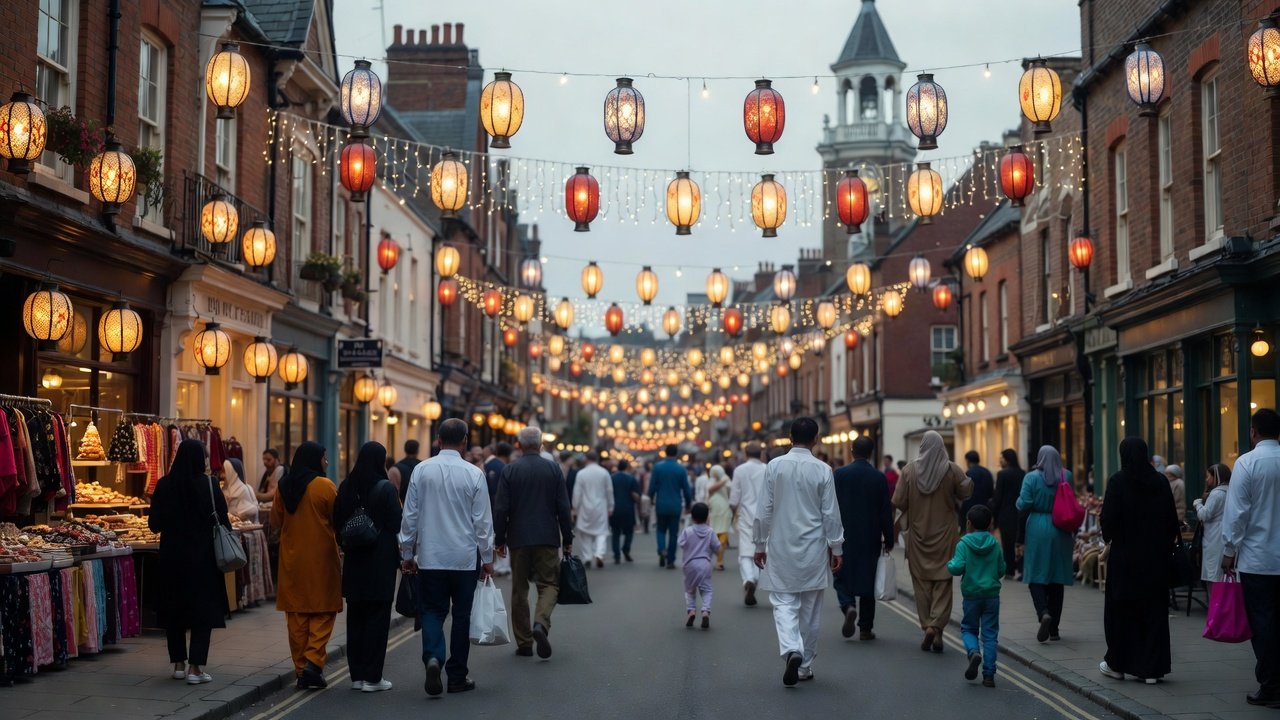
🍽️The Eid Table: Food, Feasting and British Muslim Culture
After the prayer, British Muslim homes come alive with food. The Eid feast is one of the great pleasures of the day — and it reflects the extraordinary cultural diversity of the UK's 4 million-strong Muslim community, drawing from South Asian, Middle Eastern, East African and European heritage, all woven together in a distinctly British way.
Sheer Khurma
Creamy vermicelli pudding with dates, nuts and milk. The quintessential Eid sweet across South Asian households — often the very first thing eaten on Eid morning.
Biryani
Fragrant basmati rice slow-cooked with spiced meat. The centrepiece of Pakistani, Indian and Bangladeshi households across the UK on Eid day.
Gulab Jamun & Rasmalai
Syrup-soaked sweets that appear in virtually every British Asian household on Eid. Often bought from local sweet shops in large trays to share.
Mansaf & Maqluba
Traditional Middle Eastern dishes of slow-cooked lamb with rice, popular in Jordanian, Palestinian and Yemeni British communities.
Somali Sambusa
Delicately spiced crispy pastries filled with meat or lentils. A staple of Eid celebrations in British Somali and East African communities.
Baklava
Honey-soaked pastry layered with pistachios or walnuts. Widely sold across UK halal bakeries and Turkish supermarkets during Eid.
Halal BBQ
Jerk chicken, peri-peri lamb, beef burgers and seekh kebabs at outdoor Eid gatherings — an increasingly beloved British Muslim tradition.
Eid Cakes & Sweets
British-style chocolate and sponge cakes decorated with "Eid Mubarak" — a fusion tradition that perfectly captures British Muslim identity.
Eid is also the time for open houses. It is not just common but actively encouraged for non-Muslim friends, neighbours and colleagues to be invited in for food, tea and conversation. The spirit of Eid is generous, inclusive and outward-facing — a day for sharing joy with everyone around you.
📋Is Eid al-Fitr a Bank Holiday in the UK?
No — Eid al-Fitr is not currently a public bank holiday in the United Kingdom. However, this conversation is growing. Many progressive employers, schools and public bodies now recognise Eid as a significant religious occasion and offer flexibility accordingly.
The good news for 2026 is that Eid falls on a Friday — a day that already carries lighter schedules in many workplaces and coincides with Jumu'ah (Friday prayer), which Muslim employees are already accustomed to planning around.
How to Manage Time Off for Eid
- Request leave from your employer in advance, citing Eid al-Fitr as a religious observance day. Most employers will accommodate a single day's leave without difficulty.
- Most schools will authorise absence for Eid — simply notify the school office in writing before the expected date.
- Some employers now formally include Eid al-Fitr and Eid al-Adha within their diversity and inclusion leave policies — worth checking your staff handbook.
- If you are self-employed, plan your workload accordingly — Eid weekend is not the time for client calls or deadlines.
The broader conversation about recognising Eid as a bank holiday continues in Parliament and public discourse. With over 4 million Muslims in the UK and Eid observed across every corner of the country, the case for formal recognition grows stronger each year.
🤝How Non-Muslims Can Join the Celebrations
Eid al-Fitr is one of the most welcoming and inclusive celebrations in British cultural life. If you are not Muslim but want to show solidarity, participate or simply understand what your neighbours and colleagues are celebrating, here is everything you need to know:
- Wish people "Eid Mubarak" — it means "Blessed Eid." It will always be warmly received by Muslim colleagues, friends and neighbours. You can also say Eid Saeed ("Happy Eid").
- Accept invitations to Eid meals or open houses. Arriving with a box of sweets, flowers or a card is always appreciated — and you will almost certainly leave very well-fed.
- Visit public Eid events in your city — parks, markets and community festivals are free, family-friendly and genuinely open to all.
- Give your Muslim colleagues space and flexibility on Eid day. A kind word, a relaxed approach to the morning prayer and a "Eid Mubarak!" goes a very long way.
- Try halal street food at Eid markets — some of the finest food in Britain appears at these events, and the atmosphere is unlike anything else on the British social calendar.
Eid has become a genuinely celebrated part of British life. Supermarkets stock Eid cards and decorations. High streets carry Eid banners. Schools run Eid assemblies. This is a reflection of how thoroughly and beautifully British Muslims have shaped the nation's cultural landscape over generations.
✅Complete Checklist: Preparing for Eid al-Fitr 2026
Before Eid — The Final Days of Ramadan
- Pay Zakat al-Fitr (minimum £5 per person) before the Eid prayer — ideally this week.
- Buy or prepare new or best clothes for every member of the family.
- Confirm Eid prayer time and location with your local mosque.
- Book time off work and notify school of your child's absence.
- Stock up on ingredients, sweets and gifts — halal shops get very busy on 19 March.
- Prepare or pre-cook Eid dishes where possible to free up the morning.
- Charge your phone — you will be sending a lot of Eid Mubarak messages.
On Eid Morning
- Perform ghusl (full ritual wash) — a sunnah of the day.
- Wear your best or new clothes and apply attar.
- Eat something sweet (dates are traditional) before leaving — fasting today is haram.
- Recite the Takbir on the way to the mosque.
- Use public transport or car-share — parking near mosques is always extremely limited.
- Arrive early — first congregations fill up fast from around 6:45am.
- Take a different route home from the mosque (sunnah of the Prophet ﷺ).
- Greet everyone: Eid Mubarak — Taqabbalallahu minna wa minkum.
Eid Mubarak — From All of Us 🌙
Eid al-Fitr 2026 arrives at a beautiful moment — the first day of spring, a Friday, and the deserved reward for 29 or 30 days of fasting, prayer and community. Wherever you are in the UK — London, Birmingham, Manchester, Bradford, Glasgow, Cardiff or a quiet town in between — may your Eid be blessed, joyful and filled with the warmth of the people you love.